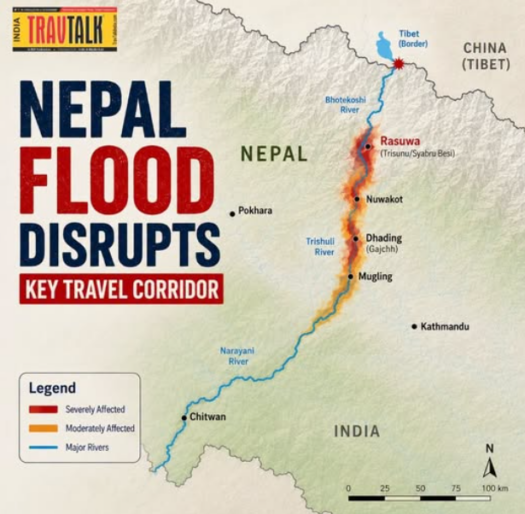
On the morning of 26 August 2026 a magnitude 5.2 seismic event was recorded in the Langtang National Park in Nepal. Shortly thereafter there was a massive and catastrophic wall of water, mud and rock that wiped out many villages, bridges and power stations, resulting in the deaths of over 1000 people. The massive flood cut a swath through central Nepal and into India and the Tibetan Autonomous Region in China. It is been called one of those once-in-a-century events. For more, read on…
To start, there has been a lot of speculation in social media about what caused this catastrophe, much of it in the way finger-pointing with the aim of gaining political points. Unsurprisingly a lot of that has been aimed at China. Our interest here is not about pointing fingers, but instead looking at the event itself and why it was so catastrophic. As it turns out, there is a perfectly reasonable natural explanation for what happened, especially considering there have been dozens of such events since the turn of the last century in Nepal. There were similar events since the turn of this century that took the lives of a number of people. So, this sort of event is not unusual in that region. And more should be expected. We begin with this event.
The seismic event took place at 08:37 local time near the Langtang Lirung Mountain close to the Chinese border. At first the authorities thought the event was an earthquake, which is not unusual for that part of the world. The Himalaya mountain range is one of the most active earthquake zones in the world. It is not unusual to have a dozen earthquakes in the Ms4 magnitude range in Nepal in the span of a month. But this event wasn’t caused by an earthquake. It was a massive glacial detachment that sent a small mountain’s worth of ice and rock crashing down over a mile into the valley below. There is a video that explains what happened in good detail. The gist is outlined in the following four paragraphs.
There are more than 3000 glaciers in Nepal. The particular glacier that collapsed was the Yala. The area of the collapse was about a mile wide at the face at an elevation of about 16,700 feet (5 km). Nepal was experiencing one of its warmest summers on record, so a lot of the fresh snow that had fallen there over the winter was melting. Yala is one of the fastest receding glaciers in the world and latest pictures before the collapse revealed a very dingy grey rock-filled glacier underneath, which absorbs a lot of heat. That extra heat accelerates the snow melt. The exposed rock showed striations, almost like an accordion.
When the ice broke free there was about a 7000 foot (2+ km) drop over the course of roughly 3.4 miles (5.5 km) which created a huge momentum and force, which would have pulverized and liquefied the ice in a snap of the fingers, causing massive amounts of water to flow down the gorge. In the Himalayas the slopes very steep and very constricted, causing the water to rise to a great height. According to helicopter surveys, they showed around 300 feet (ca. 90 meters) was the peak of the debris line. Imagine a wall of water and debris (because it’s picking up things all along the way) 300 feet tall as it works its way downstream.
Videos of the checkpoint at the China-Nepal border, about 13.4 miles from the peak of the Yala glacier, showed the flood passing there exactly 7 minutes and 40 seconds after the collapse was registered. Time and distance measurements gave a speed of the water at 105 mph (170 km/hr). There was a 10,500 foot drop from where the glacial mass hit to that checkpoint, which is quite a slope and which gave the flood mass its velocity. In comparison the Mississippi River from Minneapolis to New Orleans is 1700 miles, which only drops 750 feet, giving a very gentle flow. This flood mass dropped more than 10,000 feet in roughly 13 miles. So, we had a flood mass moving at 105 mph, comprised of a wall of water, mud, rock and debris 300 feet tall going like a tsunami down the river.
There was such force of the floodwater in that direction, smashing against the banks, that part of it actually went upstream for 1½ miles. Thirty-two miles downstream it hit the first village. The water by that point was a little bit lower. It was not a 300 foot tall tsunami anymore. It had somewhat dissipated and the speed has slowed some because the slope is a bit more gradual there. However, all that area was crushed by the water. You could see the bridge taken out in one of the videos, which is 45 miles up the river from where the collapse happened. All of these factors combined to create an affect the likes of which we have never witnessed before on camera and unfortunately in many regards completely predictable.
To summarize the destruction, then, the Gyirong checkpoint on the China–Nepal border was completely destroyed. The flood front travelled 45 miles (72 km) down the Trishuli River, striking dozens of settlements along the way. The damage was quite extensive, with rebuilding costs estimated to be on the order of $5 billion, which Nepal can ill-afford.
Of special interest here is that the flood originated near and flowed down the Trishuli River. That river is formed by the merger of the Gyirong Tsangpo (Kerung Khola) and the Lende Khola (Donglin Tsangpo) originating in Gyirong County of Tibet, which join together near the Rasuwa Gadhi on the Nepal–Tibet border. Rasuwa Ghadi is an old fort, which was swept away in the flood. But that is not the point.
The Trishuli is named after the trishula, or trident of Shiva. Shiva is one of the principle gods in Hinduism. According to legend Shiva drove his trishula into the ground at Gosainkunda. Gosainkunda is very near where the glacial event took place. The former is a large glacial lake that remains frozen for half of the year. When it melts it forms the Trishuli River. And the reason Shiva planted his trishula there? – in order to slake his thirst after having drunk the halahala poison. It was an act of supreme sacrifice, done to save humanity. There is a lot one could read into the symbolism there, but we have to leave it for one’s imagination.
The chart for the event is below (bigger):
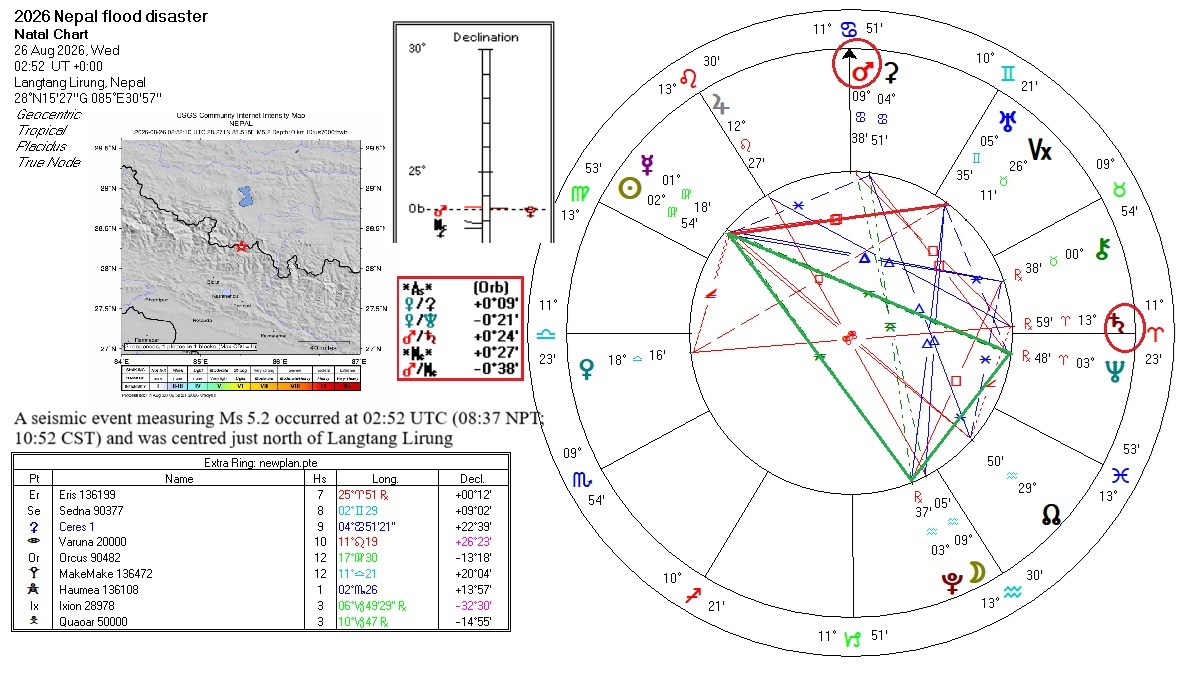
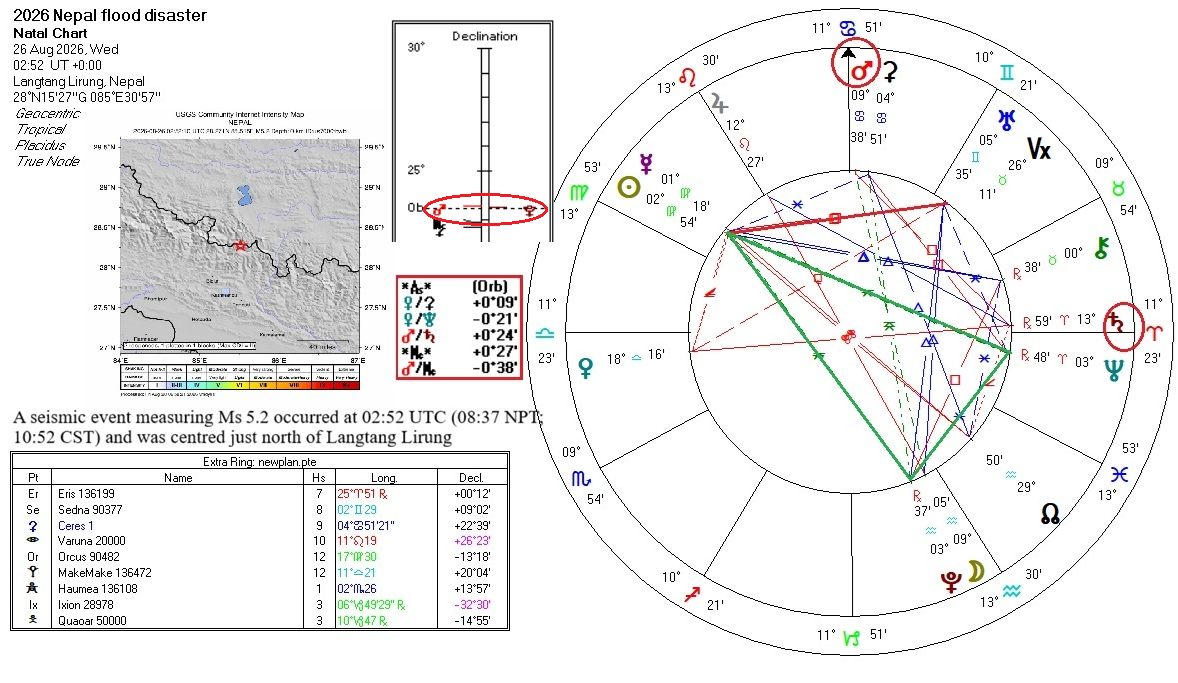
There are two immediate standouts from the chart. The first and most apparent are the conjunctions of Mars with the Midheaven and Saturn with the Descendent. The next immediate stand out is the Sun square to Uranus. The overall concept that comes to mind is that this chart represents a disaster resulting in death, for the following reasons.
Sun square Uranus often indicates accidents or sudden events. Mars and Saturn conjunct the angles set up the so-called death axis midpoint with the two angles. What they show is as follows, from Ebertin, the italicized text being the more applicable here:
-
- Mars/Sat=Asc: A person whose advancement in life takes place with great difficulty only, obstacles or inhibitions caused by other people. – The necessity to economize, illness, separation, mourning and bereavement.
- Mars/Sat=MC: Endurance, the power of resistance, indefatigableness. – The necessity to overcome a lot of difficulties in life, the ability to bear the suffering of the soul (with dignity and without complaint). Mourning and bereavement (death).
In addition there is another factor, one that will be of increasing interest over the next nine years. Pluto entered its out of bound (OOB) phase on 15 August this year and will remain out of bounds until 2035. At the time of this disaster Mars was still out of bounds, contributing to the increased violence of the event. It was contraparallel Pluto, which acts like a Mars/Pluto opposition. Mars/Pluto combinations can be particularly explosive. Again, we have the following indications from Ebertin:
-
- Mars/Pluto: Superhuman power (force, brutality): the misfortune of having to suffer violent assaults, injuries.
In the blogs on this site Reinhold Ebertin’s book, The Combination of Stellar Influences has been quoted many times. Ebertin was a proponent of cosmobiology, except he did not use the eight hypothetical planets that Witte, the originator of the Uranian School advocated. Nor do I use those planets. Instead, if one has an accurate chart then Ebertin’s descriptions of the midpoints can be quite accurate. I use them on the site as much as a proving of the method and as a look deeper into event charts.
Coming back to Pluto out of bounds (OOB), Pluto typically goes OOB in the early degrees of Aquarius. 23° 27’ of declination marks a sort of boundary for the normal operation of the planets. It is the oscillation of the Sun’s path – the ecliptic – as it traverses through the constellations. With Pluto OOB we can expect in one respect “Pluto unchained”. In other words Pluto, representing the underground, means that all things associated with the underground – hidden matters, covert matters, revelations of coverups, revolutions, possible discovery of ancient texts (gter ma), increased volcanic activity and so on.
The last time Pluto was OOB was from 1775 to 1795. It was at its peak OOB phase in 1784 and 1785. That 20 year period was an important period of revolution in the Western world. The three main revolutions that are remembered are the American Revolution, the French Revolution, the Haitian Revolution and a lesser revolution called the Liège Revolution. The latter republic was eventually absorbed into France and Belgium. But those revolutions also spawned further revolutions, which included the Napoleonic Wars in the early 19th century.
The reason the previous Pluto OOB period is important is because it brought about the reorganization of the Western world and brought an end to the age of monarchy in the West. We are at a similar point today with Pluto having just gone OOB, except what we have at present instead of monarchs is an oligarch class, but which bears striking similarities to old monarchic dynasties. For this Pluto OOB period the peak is from 2029 through 2030. It would not be so farfetched to see the oligarch class brought to heel during the present Pluto OOB period.
Coming back to the chart, the Sun is at the south node, marking something from the past that has not been addressed properly and perhaps a karmic event. Infrastructure in the region is still less than adequate although there has been cooperation between the Chinese and Nepal. Up to now that has been mainly related to transport, but this incident also highlights the fact that infrastructure along the rivers in Nepal perhaps needs to be moved further away from the rivers or higher up the slopes.
The Sun is the apex of a yod with the Uranus/Pluto sextile as the base, showing the instability in the environment surrounding the event. Likewise, Pluto is the apex of another yod with the Sun and Ceres in sextile. Ceres is at a symbolic disaster degree in the sign Cancer which reads as follows:
-
- At a railroad crossing an automobile is wrecked by a train. 5° Cancer
All told, the chart is a fine example of one that describes a disaster. This brings up another point. Sometimes people will ask for the astrological indications for the best times of booking a flight, for instance. It has been my experience that the time of take-off for a given flight is not the determining factor in any problems with a given flight. The problems exhibit themselves when one or more of the angles of the chart click into midpoints or aspects that might indicate troublesome circumstances.
In regard to the preceding, it is always a good idea for looking at travel times to look at the prevailing aspects of the day and to see if the angles for specific times that day coincide with what might be described as perilous. That said, if one is to experience a ‘challenge’ during travel it will show in their natal chart along with an event chart. We have another example shown in a past event, though we could also show the same in airline disasters.
Italy bears the memory of a disaster similar in many respects to what just happened in Nepal. It is known in Italy as the Vajont disaster. It was caused by the catastrophic collapse of a mountainside (Monte Toc) into the reservoir behind one of the world’s tallest dams, the Vajont. That collapse caused a wall of water to overtop the dam in seconds, sending a 250 ft. tall wall of water crashing down into the valley below at high velocity. The town of Longarone was gone in seconds, as well as the villages of Pirago, Rivalta, Villanova and Faè. They were all eventually rebuilt, but around 2,000 people lost their lives in that disaster. The chart for that event is below (bigger):
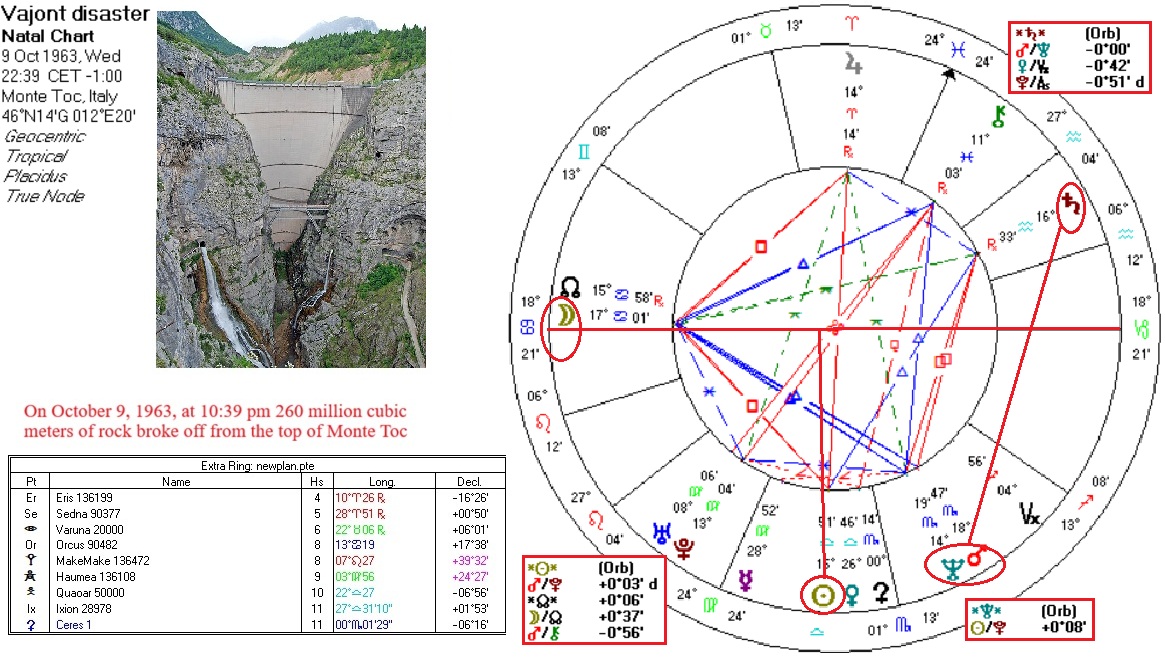
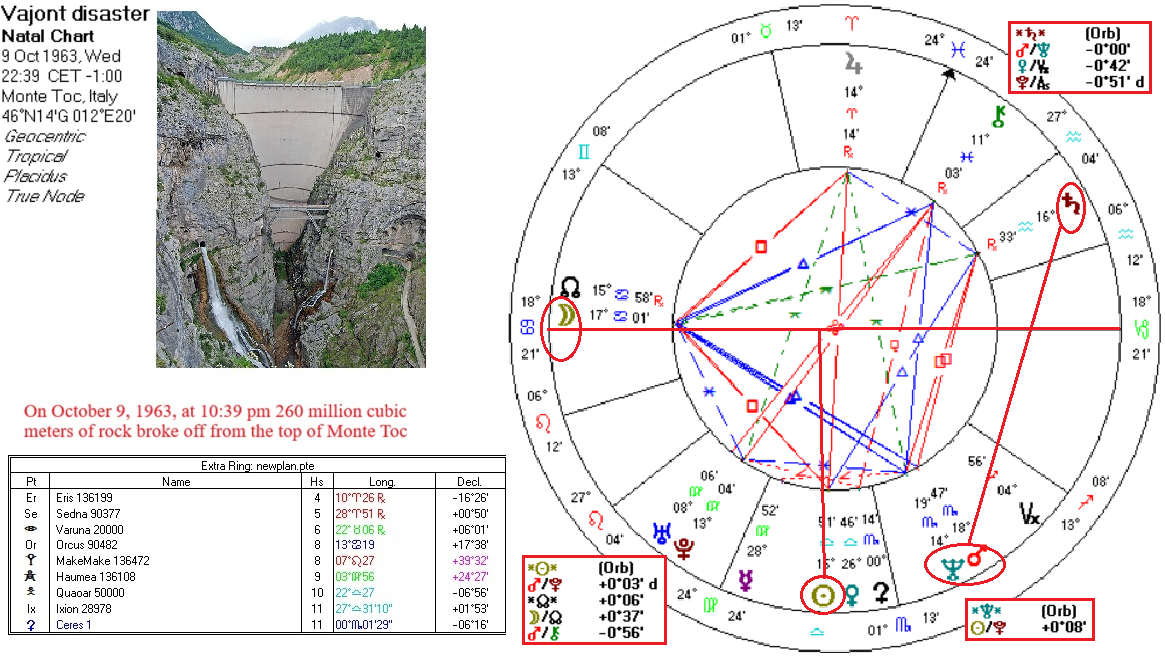
Regarding what was just mentioned about choosing flights and having the angles determine when disasters happen, we see at the moment of the Vajont disaster that the Ascendant of the chart had just passed the position of the Moon. The Moon was in Cancer, a water sign and the sign the Moon rules. The disaster began to unfold a minute or two before the actual event itself as the mountain weakened. At the time of the event the Ascendant had just crossed the square to the Sun which also activated the Mars/Pluto midpoint.
Before describing the midpoints involved in this chart, it should be noted that there was a Moon wobble on that day, with the Sun at the bending of the nodes and the Moon at the North node, making that particular Moon wobble that much more powerful. Moon wobbles often show up in disasters. The Sun and the Moon were squared. The massive scale of the event was shown by the Sun in opposition to Jupiter, with the Moon and north node marking the apex of the t-square formed by the base opposition.
Similar to the disaster in Nepal, we note also the Mars/Saturn square in this chart, which goes to form the exact midpoint structure of Saturn with Mars and Neptune. In that vein the midpoints shown in the disaster tell the tale:
-
- Sun/Plu: “Physical suffering, martyrdom. – Danger to life, separation by Providence (force majeure).” With Neptune at the 45° modulus: “lack of vigour. – The undermining of health or of vocational position, martyrdom.”
- Sat=Mars/Nep: Mars/Neptune midpoints are often shown in events involving people who work with or are involved with water. With Saturn at the midpoint we have: “Instability, feelings of inferiority, misdirected energy. – Unfortunate consequences as a result of a weak will, lasting weakness or illness.”
- Sun=Mars/Plu: “Injury, accident, violent measures, an upset or shock caused through the intervention of Higher Power.”
Fortunately in the Vajont disaster that came during the night when most people, especially children, were asleep. Most people who died would not have known what had hit them. At the same time, there would have been no warning and no time to respond, hence the high number of deaths. Lawsuits were filed by the survivors immediately after the event when news came out that the dam was knowingly constructed in a geologically unstable area and mismanaged.
The wheels of justice in Italy turn very slowly, especially when big money and government projects are involved. Only two of the 11 people charged went to jail for the incident, 8 years after the fact, while another committed suicide. Compensation payments for the families of the victims didn’t come until the year 2000. From a previous link:
“…builders and managers had failed to observe soil conservation requirements and filled the reservoir well in excess of safety regulations. Finance-related concerns and a blind faith in development and technical expertise had eclipsed real consideration of environmental factors in the valley and of the threat to human life.”
The Vajont Dam still stands, unscathed by the event, a testament to the engineers who built it. But it is a mere shadow of what it was designed for, made so because the top of a mountain has rendered its reservoir unsuitable for major power generation. Problem is, the planners did not take into account the geology of the mountain when they surveyed the region, which was unstable to start and full of layers of clay, which dissolved and loosened in the water as the dam was filled. The families who had lived in the region for generations knew Monte Toc was unstable, but folklore was never going to stand in the way of progress…right?
What does all of the preceding signal for us in the long term as a result of these two disasters? Firstly, with Pluto out of bounds now we can expect more of the same and similar ‘geologic events’. Along with that, we can expect to see planners and engineers under the spotlight for miscalculations or negligence that contribute to such events. The Himalayas form the boundary between Nepal and China. As one of the most geologically active regions in the world extreme care has to be made in any planning. Contingencies will have to be put in place, and most likely at great expense which Nepal at present can ill afford.
And then there are the geopolitical considerations in the region, with the Western powers seeking to hold back development by China in the region and the needs of the Nepalese on the other hand, which naturally is bonded with China. India plays a hand in the geopolitical considerations there as well. Nepal is bounded by two of the BRICS nations, India and China. Nepal could benefit from that, whereas Western interference will seek to keep Nepal as a wedge between the two. Nepal serves as a natural gateway between India and China.
So, we have looked at two similar disasters, both involving unstable mountains, mountain valleys with very steep and narrow walls, and communities that are built along the rivers that flow through those valleys. The potential for serious events in such regions is ever-present. But further from that, there is also the astrology of such events, that when properly assessed will go toward forewarning such events into the future which may save many lives. But that will come more in the future when astrology is applied more scientifically and is more broadly accepted. For now, we honor the victims, along with their families and friends who have lost loved ones. May lessons from disasters be well-learned and may such disasters thus be averted into the future.
Featured pic from TravTalk