November 10th is a solemn day of remembrance for Merchant Mariners in the US and abroad. On that day 50 years ago, during a November storm, the SS Edmund Fitzgerald broke in half and sank to the bottom of Lake Superior. There were no survivors. In this post we take a look back at the event itself and the astrology of the event. As it turns out, there are aspects to this tragedy that have yet to be resolved even today. For more, read on…
Before we get into the event itself and the astrology, though, sit back, relax and reminisce with this famous ballad by Gordon Lightfoot.
When the Edmund Fitzgerald incident happened I was in university at the time studying physics and playing music. The only thing I knew about the Edmund Fitzgerald was the ballad, above. Merchant Mariners on the American Great Lakes saw one of their superstitions fulfilled with that wreck and suffered the loss of their mates, as well as did the families and friends of the crew of the Fitz, as mariners call the ship. We will look at the disaster itself in reference to the astrology of the event below. And there are a few matters which still plague American shipping to this day which get a mention toward the end of this post.
To begin, in the song lyrics, above we hear reference to Gitche Gumee, a term with which Americans are all-too-familiar:
The lines are of course from the long poem by Longfellow, “The Song of Hiawatha.” Gitche Gumee is the Ojibway First Nations peoples’ name for Lake Superior — Otchipwe-kitchi-gami – the ‘Big Sea’ or ‘Huge Water’. Lake Superior is the largest freshwater lake in the world by volume. It contains as much water as the four other Great Lakes combined. It is a major waterway stretching between the US and Canada, and a vital transport link for the US steel and construction industries. The major products that are shipped along these five lakes are used primarily in construction and the steel industries – coal, sand, road salt, cement, taconite (a cheap iron ore) and to a much lesser extent grain from the Midwest. This transport route is by far the cheapest way to ship such bulk materials.
There is also a lesser canal that links the Great Lakes to the Mississippi River system, allowing a continuous transit link from the Gulf of Mexico to the St. Lawrence River mouth. That canal is known as the Illinois Waterway and stretches from Chicago to Grafton, where it empties into the confluence between the Illinois and Mississippi Rivers, just so you know.
There is a YouTube channel by a North Carolina resident of Italian ancestry – what’s not to like? – called What’s Going on With Shipping? where he outlines a lot of info about shipping on shipping across the world and in the linked video on shipping on the Great Lakes, and which gave me the inspiration for writing this post. I was born and raised in North Carolina. The featured picture for this post comes from one of the videos that he mentions in his post on the sinking of the Edmund Fitzgerald. That brings us to the ship itself and some background.
To begin, you may not know this (I didn’t) but Section 27 of the Maritime Marine Act of 1920 (a.k.a. the Jones Act) “requires that all goods transported by water between U.S. ports be carried on ships that have been constructed in the United States and that fly the U.S. flag, are owned by U.S. citizens, and are crewed by U.S. citizens and U.S. permanent residents.” The Fitz was an American ship. That act will be important toward the end here.
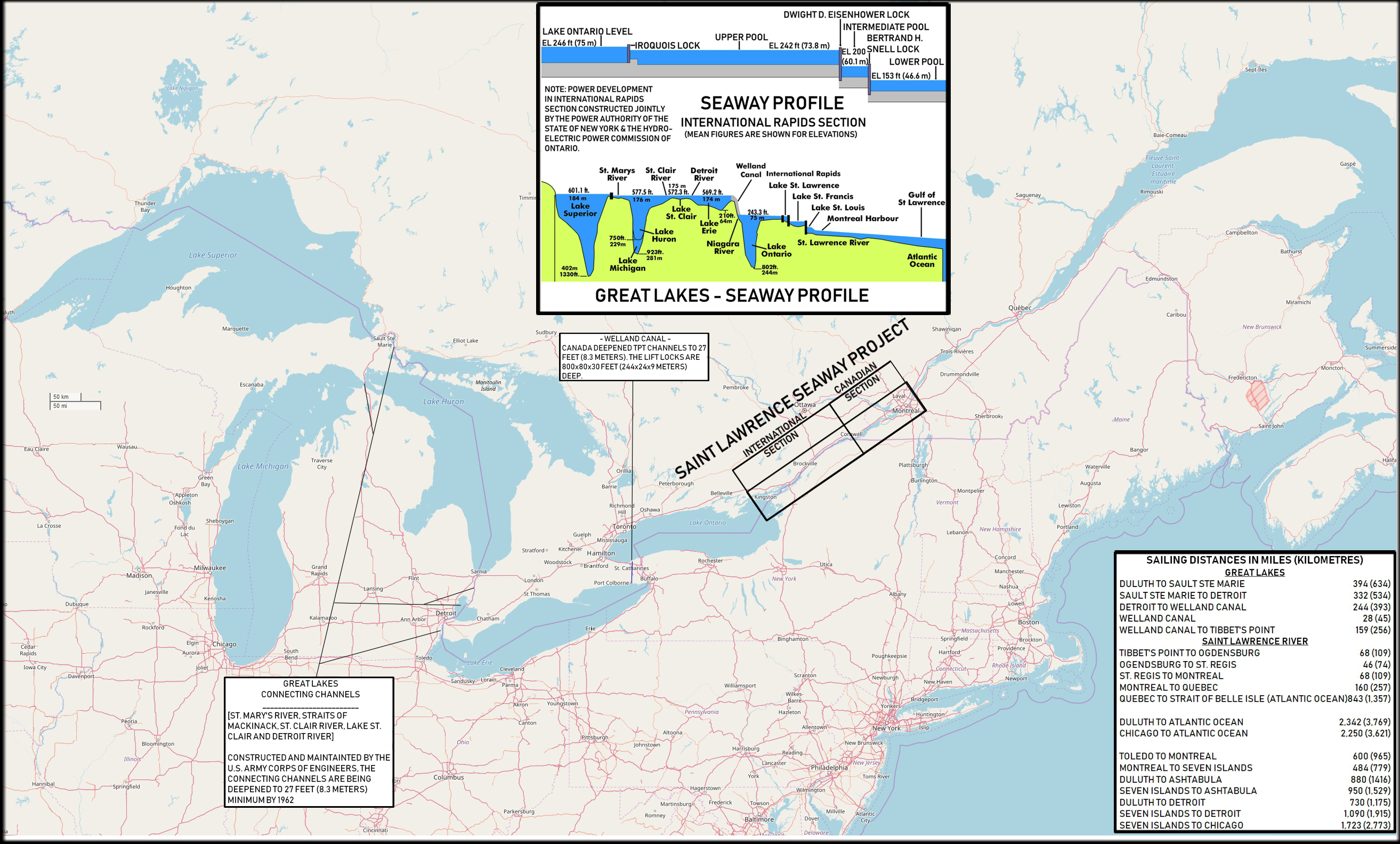
When the Edmund Fitzgerald was launched on June 7, 1958 she was largest ship on the Great Lakes and remains the largest to have sunk there. She was commissioned by the Northwestern Mutual Life Insurance Company. The keel was laid at the Great Lakes engineering works of River Rouge, Michigan. She was the namesake of the president of Northwestern Mutual, one Edmund Fitzgerald (1895–1986). At 729 feet in length (222 m) she was the largest ship of that time to traverse the Great Lakes. We might ask, why was the ship 729 feet instead of 730 or more? As it turns out, the locks at the Welland Canal between Lakes Erie and Ontario (at Niagara Falls) only permit a maximum ship length of 740 feet (225 m). So, the Fitz was able to transit the entire Great Lakes Waterway. But to hear Merchant Mariners talk about her, however, the Fitz was cursed from the very start.
Why would mariners say the ship was cursed from the very start? The superstition is along the lines of a bad launch being a bad omen, meaning a trouble-plagued ship. When the ship was launched, the wife of the man, Edmund Fitzgerald, was given the honor of breaking the champagne bottle over the bow. With a good launch this is done on the first attempt. It took her three times to break the bottle. That was the first and worst omen. When the ship was launched the dockworkers had trouble removing the slip blocks. Once the ship was freed and slid down the slip ways, it listed hard to the side, to the extent it looked like it might sink – the 2nd omen. Instead it crashed into a pier and in the process created a huge wave that doused all the people who had come to watch the launch. A third omen.
There were 10,000 people there at the day of the launch, and one of the men observing the launch had a heart attack as a result of what he saw and died at the scene. Was that enough omens and a bad start? Apparently so. But the Fitzgerald eventually righted itself and got underway. But as mariner superstition would say, the ship was doomed to troubles. That would turn out to be true 17 years later. Once the Fitzgerald left the port she completed her nine days of sea trials, and then went on to complete 17 years of record-breaking service. Her maiden voyage was on September 24, 1958.
The Fitzgerald was a grand old ship. She was outfitted with the best of everything – the most modern navigation and radio equipment, large air conditioned crews’ quarters with deep pile carpet, two kitchens, an exercise area on the deck, and so on. All this was described in the doco from which the featured pic was taken. A merchant mariner on the Great Lakes on the American side considered he had made it to the top when he got a posting on the Fitzgerald. But then, on 10 November 1975, a large November storm – greatly feared by mariners on the Great Lakes – came up suddenly. The Witch of November had come stealing. At 19:15 that evening, contact with the Fitzgerald was lost. We will not go into the details of how the Fitzgerald ended up at the bottom of Gitche Gumee. The documentary just linked goes through events in great detail, along with descriptions of the ship, her captains and so forth. Wikipedia (which I do not normally use) has a decent write-up on it, too. Instead, we go straight to the chart of the event, which is below (bigger):

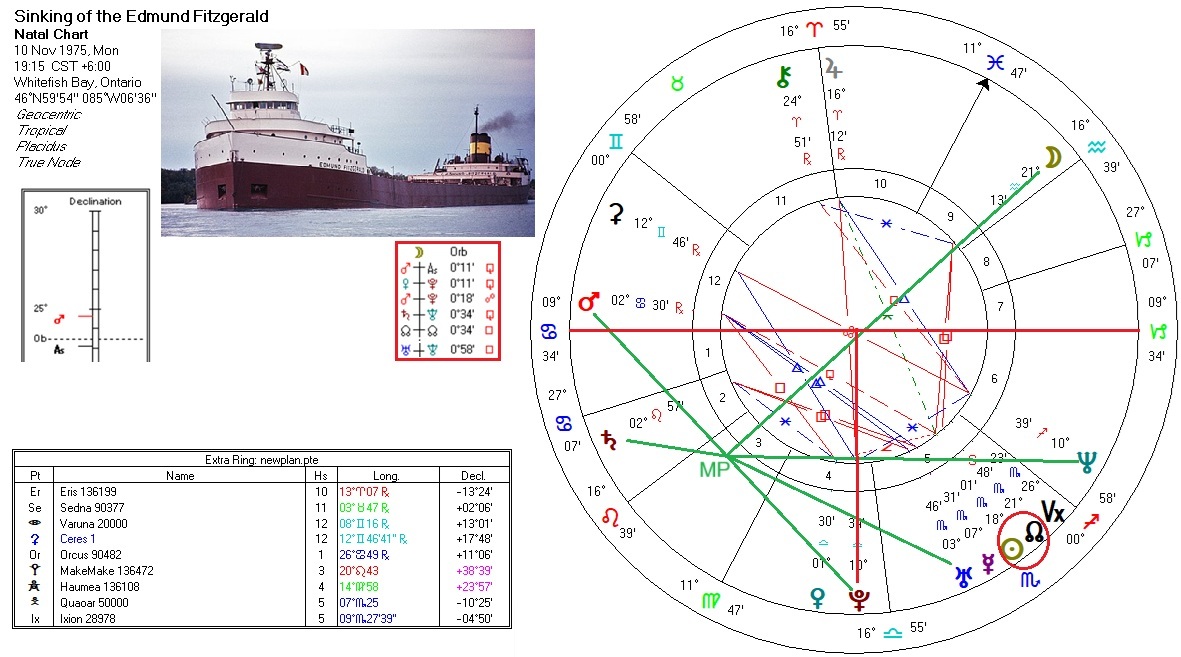
This chart is a good study and review in astrological rulerships, midpoints, disasters and rectification. We know the sinking happened at approximately 7:15 pm CST because the ship had radio communications and radar contact just five or so minutes before it disappeared in total. We take that time as a starting point. The first stand out in the chart is the out-of-bounds Mars, which always tends to present its share of disasters and violent events. This was no exception.
Most often in shipping disasters we look at the planet Neptune, as it rules over deep waters. But in this case we are not looking at the oceans. Instead we will look to the Moon for navigation disasters of this type. The Moon rules lakes (landlocked bodies of water) and smaller bodies of water – smaller than oceans, though it could be rightly argued that the Great Lakes are actually inland oceans, or seas due to their sheer size. The Moon also rules ships, and ruled over all bodies of water and ships until Neptune was discovered.
The shipwreck occurred during a Moon wobble (showing heightened emotions and instability), with the Sun conjunct the North node in Scorpio (a water sign) and squaring the Moon in Aquarius. The Sun was also sesquisquare to Mars. Mars was in Cancer (another water sign and the sign of its fall), retrograde in the 12th house (unexpected troubles) just behind the Ascendant. That is a very dicey placement for Mars when it is found in stressful situations, pointing to emotional overreaction, over-focus on security concerns and undermining influences.
The Ascendant was around 9° of Cancer, with the Horizon axis square to Pluto. Mars was in a receding square to Pluto due to the former’s retrograde motion. However, Mars and Pluto formed a midpoint with the Moon at the time of the wreck. In fact, all the planets from Mars through to Pluto formed midpoints by either 45° or 90° modulus with the Moon at that time. So we have the following midpoints:
-
- Moon=Mars/Pluto: The misfortune of having to suffer violent assaults, injuries; Audacity and daring, impulsiveness, ambition.
- Moon=Saturn/Neptune: Undermining circumstances also leading to a state of illness; Emotional depression, pessimism
- Moon=Uranus/Neptune: A fit of weakness; Confused psychic states, peculiar inclinations, losses.
In addition, Saturn and Uranus were in square, showing possible violence, interventions in one’s destiny, and the limitation of freedom.
The Uranus/Neptune midpoint often points to loss of consciousness. In this case the loss of consciousness was due to the inclement weather – which can also be shown by Uranus/Neptune combinations, and the high seas. The waves at the time of the wreck were said to be 25 feet high (7.5 m) and higher, having been whipped up by the high winds. It was also snowing at the time. The winds were hurricane-force. It was later found there were rogue waves (‘three sisters’) on the day, too, rising to a height of 36 feet (11 m), which also produce deep water troughs as they pass. Depending on the angle at which such waves hit a ship, especially a long ship, the shear force from such waves can test even the sturdiest of hulls.
Speaking of Mars out-of-bounds, another (unrelated) disaster happened the day after the Fitz went down. The GG of Australia, under pressure from MI6 and the CIA, dismissed the Whitlam government. It was a disaster for Australia and was used to bring in the era of financialization to Australia under successive governments. That is another story. But there is another remembrance on the 11th of November every year in the United States – Veterans’ Day. We will have a bit on the latter toward the end here, because it is related to the Merchant Marines.
The Saturn/Neptune midpoint points to weakness in a body (in this case a ship) and is a disaster midpoint. Mars/Pluto is a classic disaster midpoint, often seen in violent events, such as this was. Uranus and Pluto both rule catastrophes. Mercury was conjunct Uranus on the day, pointing to problems with communications and with transit, and square to Saturn. Saturn/Uranus squares often show in heightened tensions as well as disasters.
The angles of the chart are both water signs, with Cancer rising and Pisces at the Midheaven, the two signs most associated with the sea and sailors. Neptune was sextile to Pluto and trine to Jupiter, showing a large storm, with Neptune in the 6th house (long journeys over water for profession) in Sagittarius. Ceres was approaching its opposition with Neptune by retrograde motion in Gemini. As we have seen many times in these posts, Ceres can have a Pluto-like emphasis in events. In such cases that shows as a turning point. Up until the wreck itself, the captain, McSorley said that everything was under control on the Fitzgerald. Five minutes later all communication were lost.
So what happened to the Fitzgerald? Here it is of interest to watch how the chart ‘evolved’ through the events. At 15:30 local time the Ascendant was within orb of the opposition to Uranus and square to Saturn (overcoming of sudden difficulties jointly with others), at which point McSorley, the captain had reported he had lost two deck covers and the ship was taking on water. The ship had lost a railing and was listing.
At 16:10 McSorley reported the radar had failed. The Ascendant then was opposite the Sun and square to the Moon, thereby activating the Moon wobble, showing a crisis situation. Sun/Moon combinations feature strongly in relationships and at that point tensions on the ship were bound to be rising. The ship was experiencing trouble. At 16:39 McSorley contacted USCG station at Grand Marais, Michigan to enquire if the radio beacon and searchlight were working at Whitefish Point, to which he received the reply that both of them were out of order. The ship was sailing blind. The Meridian axis for the chart at that point was conjunct Saturn and squaring Uranus (a sudden emotional or occupational crisis).
Minutes before 17:30, the Ascendant had clicked into the Ceres/Neptune opposition (a turning point in conditions at sea), which is when the weather and the seas began to sharply intensify. At 17:30 McSorley reported the conditions at sea were some of the worst he had ever experienced. By 18:00 the Arthur A. Anderson was reporting waves as high as 25 feet with gale force gusts of wind. The Anderson was struck by 70-to-75-knot (130 to 139 km/h; 81 to 86 mph) gusts and rogue waves as high as 35 feet (11 m). The Anderson was only 10 minutes behind the Fitzgerald. So, the Fitz would have been experiencing much the same. By 18:00 the Midheaven had just crossed the Moon, and was squaring the nodal axis – in other words, the Midheaven was activating the Moon wobble.
At 18:46 the Ascendant was conjunct Mars. This was just before the catastrophe. At 19:10 the last radio contact with the Fitzgerald took place. The Midheaven squared the Ceres/Neptune axis. McSorley stated at that time they were holding their own. The radio went silent and all radar contact was lost ten minutes after that. At 19:08 the Moon came into orb of the Saturn/Neptune midpoint (weakness in the body, an illness) at the 45° modulus.
At 19:20 the Moon was also at the Mars/Asc midpoint (quarrels, conflicts, disputes) at the 45° modulus. What was happening on the bridge of the Fitz, then? Was there an argument, an altercation, a misjudgement due to emotional pressures that caused a serious lapse of judgement that caused the ship to perform a fatal manoeuvre? Any knowledge of those moments went to the bottom of Lake Superior with the Fitzgerald. Having taken all the preceding in, along with the initial starting time for the disaster at 19:15, we can probably say conclusively from the astrology that the Edmund Fitzgerald sank at 19:20.
The Fitz would have made safe harbor at Whitefish Bay about an hour further on at top speed. She almost made it. What caused the ship break in half and sink? Nobody really knows. It could have been a combination of factors – weak hull in extreme weather and sea conditions, may have been swamped, grounding on the 6 fathom shoal. The ship was fully loaded with taconite pellets. There are all sorts of theories as to what happened, none of them conclusive. The captain had lost visibility and had to rely on another ship’s radar for guidance. Normally there would have been a radio beacon at Whitefish Point, but it was out of order that day and they were trying to get it back online. So, the captain of the Fitzgerald was really up against the odds.
The combination of the high waves, which also cause deep troughs would have magnified any weakness in the hull of such a long ship. A comment under Sal’s video cited a relative who used to do repairs on the Fitz and said the hull of the ship was always weak. Yet, as for the shoal theory, the shipwreck lay 530’ (162 m) at the bottom of Lake Superior instead of close to that hidden shallow shoal. The Fitz broke almost cleanly in half. No one has yet been able to prove conclusively what caused the ship to break apart and sink.
The entire crew of 29 mariners lost their lives in the sinking of the SS Edmund Fitzgerald. Only a single body was ever observed when searchers found the ship. His remains were laying face-up on the bottom beside the ship. He was never identified. The wreckage site has since been declared a maritime graveyard and sacred site, with dives to the site and scans of any type being strictly forbidden without permission from the Canadian government. This is as it should be. Let the sailors rest in peace.
The worst thing for the families of those sailors is that they do not know what happened, and never likely will. In another of the comments under Sal’s video it was claimed that the maintenance records for the Fitz were quickly hidden away, suggesting a cover-up. There again, we do not know.
However, disasters do often result in needed improvements. In 1977 the US Coast Guard started requiring the use of depth finders on all vessels of 1600 tons and over. Since 1980 survival suits have been required aboard ships in each crew member’s quarters with strobe lights affixed to the jackets and survival suits. A LORAN-C positioning system for navigation on the Great Lakes was implemented in 1980 and later replaced with GPS in the 1990s. Emergency position indicating radio beacons are installed on all Great Lakes vessels for immediate and accurate location in the event of a disaster.
Navigational charts for Northeastern Lake Superior were approved for accuracy in greater detail. The NOAA revised its method for predicting wave heights. The USCG rescinded the 1973 load line regulation amendment that permitted reduced freeboard loadings. And finally the USCG began the annual pre-November inspection program recommended by the National Transportation Safety Board. Coast Guard inspectors now board all US ships during the fall to inspect hatch and vent closures and lifesaving equipment.
A deckhand on the Arthur M Anderson during the 1975 storm said that storm changed the way things were done. He stated, “After that, trust me, when a gale came up we dropped the hook [anchor]. We dropped the hook because they found out the big ones could sink.” Another comment stated that since the loss of the Fitz “some captains may be more prone to go to anchor rather than venturing out in a severe storm, but there are still too many who like to portray themselves as heavy weather sailors.”
The day after the wreck the Mariners’ Church in Detroit rang its bell 29 times, one for each lost life. The church held an annual memorial each year until in 2006 the church broadened its memorial ceremony to commemorate all lives lost on the Great Lakes. After Gordon Lightfoot died on May 1, 2023 the church bell was ceremoniously rung 29 times in memory of the crew plus an additional ring in memory of Lightfoot, who committed their deaths to posterity.
The ship’s bell was recovered from the wreck on July 4, 1995. A replica engraved with the names of the 29 sailors who died replaced the original bell on the wreck. The original bell, recovered from the Fitz, was restored. The original bell is on display at the Great Lakes Shipwreck Museum in Whitefish Point near Paradise, Michigan. All of this brings us to today and shipping in the Great Lakes.
In the US last year only five merchant ships were built. At the height of WWII American shipyards were turning out three merchant ships per day, most of them being Liberty ships – cargo vessels. Currently the US fields a total of 90 flagged merchant vessels, out of a total field of 110,000 worldwide. It is an appalling disparity for the nation that used to be ‘the arsenal of democracy’. Since the ‘80s the US has built a total of one ship for shipping in the Great Lakes. Apparently outsourcing has killed the US merchant marine fleet. Added to that, US manufacturing that used to require a large merchant fleet has been offshored. The reason? – globalization and financialization. From the link above:
“In December 2024, Senator Scott Kelly (D. AZ), Representative Todd Young (R. IN), and then Representative Mike Waltz (R. FL) (now the President’s National Security Advisor) co-sponsored a bill to revamp shipbuilding in the United States. Titled the Shipbuilding and Harbor Infrastructure for Prosperity and Security (“SHIPS”) Act, the bill did not pass in the 118th Congress, but every expectation is that it will be introduced again in 2025. In that event and should Congress enact it, the SHIPS Act will fundamentally transform shipbuilding in the United States.”
For the first time in 35 years (2022) a new freighter was added to the Great Lakes American fleet, the SS Mark. W. Barker. It was built at the Fincantieri Bay Shipbuilding Company in Sturgeon Bay, Wisconsin (yes, the company is Italian-owned and is a huge multinational). Hopefully it is a sign that merchant shipbuilding in the US is picking up. Large ocean-going naval vessels are fast becoming legacy items with the advent of anti-shipping missiles, aircraft carriers especially. Coast Guard ships are another matter and will always be needed. But merchant ships will always be needed for trade.
Note to Trump and Co.: Pass the SHIPS Act. A growing and large merchant fleet is a sign of a healthy manufacturing sector, as in real American jobs. Gig jobs are not real jobs. AI and cryptocurrency aren’t going to save the country. Whatever happened to all that campaign talk about re-shoring American jobs? And the Canadians, they are building ships for the Great Lakes, too – in China and Croatia. Way to support your local economy, Carney – not.
Merchant Marines are vital to the world’s economy. The mariners of the Great Lakes made it possible for the American Northeast to have been the manufacturing powerhouse it once was, and still is in places. Many of America’s great cities owed their very existence to the Merchant Marines – Chicago, Detroit, Buffalo, Cleveland, Milwaukee, Toledo, Erie, even Green Bay.
We may not shuffle off to Buffalo so much on honeymoons any longer, Detroit is no longer the world’s chief automaker (the Japanese won on that one) and Motown is gone, most Americans these days probably cannot name the beer that made Milwaukee famous and ‘Invincible Vince’ and the Packers are a distant memory. But the Great Lakes Merchant Marines made them possible at the time and they are a part of America’s folklore and history, at a time when the US really was ‘king of the hill’ and looked up to across the world. We owe the Merchant Marines of the US a great debt – and still do.
The Merchant Marines have been called ‘the forgotten service’. Without their service the Allies in WWII would have been hard pressed to win the war. They have been vital to every conflict involving America since. Logistics win wars, more than any number of soldiers. The Merchant Marines lost more mariners in WWII per capita per branch than any other service. This is not to romanticise the service, but to point out simple facts. The large convoys of supply ships going across the Atlantic in WWII suffered huge casualties. One in 26 merchant mariners lost their lives in that war.
Wars aside, the Merchant Marines carry on. The raw materials from which our infrastructure is built are likely shipped by Merchant Marines. The salt that keeps the roads open in the winter months is likewise shipped by them. All manner of foodstuffs are carried in merchant vessels, both at home and abroad. It all gives us pause to stop and think – and remember. Even today, however, the Merchant Marines are a forgotten service, except for YouTube channels like Sal’s (do check him out) and other media that keep our awareness alive about these mariners.
November 10th each year is a day of remembrance on the Great Lakes. The day after, on the 11th is Veteran’s Day in the US. It should also be a day of remembrance for the Merchant Marines. But for those 29 souls who lost their lives when the Witch of November came and stole them away, Gordon Lightfoot’s ballad will keep their memory alive for many generations to come.
Feature pic from YouTube (mentioned above).
My Dad was a German merchant mariner born in 1904 who went to sea at 14 on the tall ships picking up wheat from Australia. He is classified as a Cape Horner in that he sailed from east to west around Cape Horn to Chile. He arrived in Adelaide in 1926, where he stayed as he had contracted typhoid and ended up in the RAH for six months and the ship had left. I have been hearing stories of the seas and shipping from an early age. That’s why this story was so interesting. This year on October 10th I sailed on a 48 foot catamaran from Cairns to Surigao in the Philippines. We arrived on November 3rd and had to weather the first cyclone Tino on Nov 4/5. I managed to leave on the Wednesday but an amazing spate of cyclones and floods have hit the area even Darwin since. I look forward to your next blog on the astrology of that time and onwards.