In a previous post we looked at the sinking of the SS Edmund Fitzgerald, focusing on the astrology of the event itself. In this post we will focus on the launching of the ship – the birth of the ship – and compare it with the event chart to see if indeed events such as ship christenings and other birth events foreshadow significant events to the entity going into the future. For more, read on…
In order to accurately read and forecast events, it is essential to obtain an accurate chart time to the minute. All horoscopes can be seen as event charts, with the timing to the minute giving the ascendant/horizon axis and the corresponding other angles. The angles of the chart are the essential ingredients of any astrological forecasting.
So, we come to the christening event for the SS Edmund Fitzgerald. The information is taken from a book just published by John U. Bacon, The Gales of November: The Untold Story of the Edmund Fitzgerald, from which he has kindly given us the following excerpt:
“For the christening of the SS Edmund Fitzgerald, Northwestern Mutual went all out. President Edmund Fitzgerald invited the public to join the launch ceremony on Saturday, June 7, 1958, at the GLEW dock on the Detroit River.
From just this excerpt we have the date and the location, the location also being an essential factor in forecasting. Continuing:
“The launch attracted an impressive 15,000 spectators, more than the Detroit Tigers averaged per game that season. A veritable flotilla of 250 recreational boats – many of them Michigan made Chris Crafts, with their distinctive white hulls and chocolate brown mahogany decks – flying American flags from wooden poles off their sterns, bobbed in the waters nearby to get a closer look.
The Fitzgerald’s baptism at 12:34 pm produced a mighty splash, a wave big enough to douse many of the well-wishers on the far side of the inlet, and a thunderous ovation from the expectant crowd – and then another splash, as the ship rocked back and forth until she banged into the opposite peer, hard.
The Detroit News called it “the biggest object ever dropped into freshwater.”
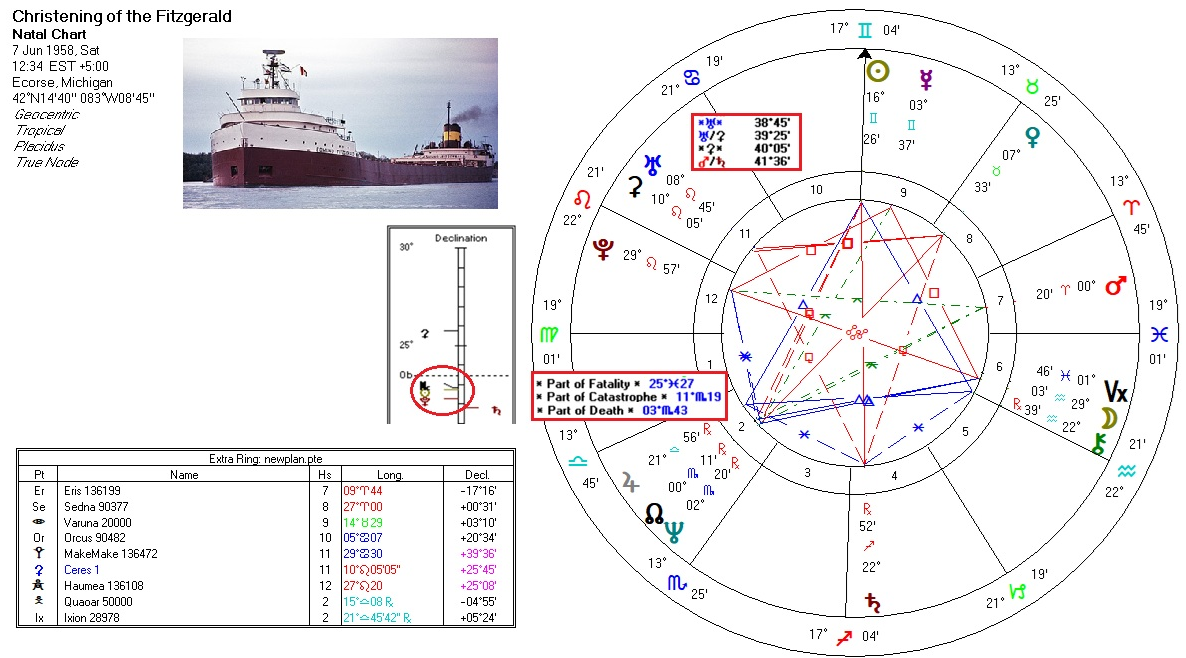
So, we have all the information needed for a correct ‘birth’ chart for the Fitz. The chart of for the event is below (bigger):
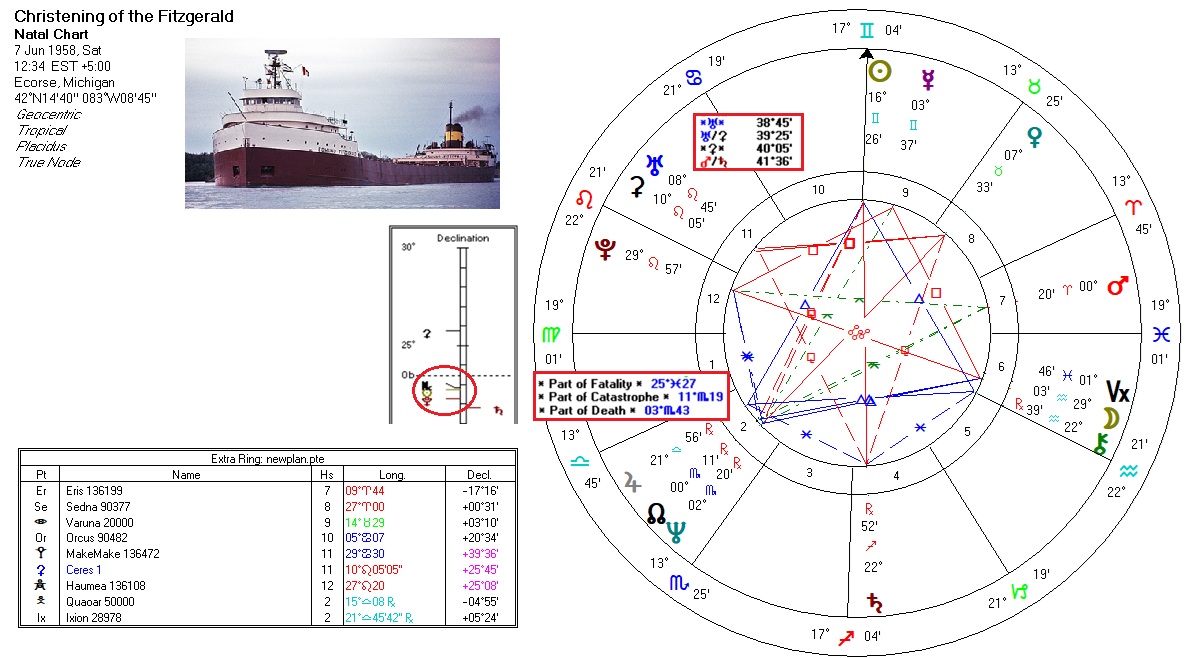
In the previous post on the Fitzgerald we noted that the christening had an ominous note to it. The customary christening bottle did not break on the first attempt. We note in the christening chart the Venus square to Uranus (unusual events and/or relations regarding women) with Saturn at the apex of the Finger of the World pattern that the Venus/Uranus square forms with Saturn. That showed the difficulties with the launch. The dockworkers had trouble removing the slip blocks which allowed the ship to enter the water. One of the spectators had a heart attack while witnessing the event and died at the scene. Any superstitious sailor would have told you those were terrible omens for the ship. What else do we see in the chart?
The other immediate standouts from the chart are as follows: The Sun is in Gemini conjunct the Gemini Midheaven (MC) from the ninth house (long journeys). The Sun is opposed to Saturn, which is retrograde in the fourth house (the birthplace). The 4th house Saturn forms the apex of the finger of the world configuration just mentioned. In a human birth chart this would indicate a difficult childbirth. Venus is also square to Ceres, which is conjunct Uranus on the other side. Ceres conjunct Uranus will show as sudden turning points in destiny. All this is stressful enough, but then we begin to see the other factors.
Mars is at the 0° Aries point at the apex of a yod with Neptune and Pluto forming the base sextile, to which we will return. It is actually crucial to beginning to understand why the ship sank. In addition we see a t-square with Mercury at the apex in Gemini, with the Moon opposite Pluto as the base opposition. This showed the far-reaching plans for the ship and the extreme effect it would have on public consciousness. Then we come to Neptune.
Neptune and the Sun are in sesquisquare, with Neptune in Scorpio conjunct the north node, the latter being a very watery and emotionally tumultuous placement. It can also indicate hidden dangers in the depths of the sea. Venus is in a wide opposition to Neptune, and Mercury is in a quincunx with Neptune. Neptune should feature heavily with seafaring vessels. Mercury rules the Ascendant (ASC) and MC of the chart. The quincunx at the same time shows the allure of the vessel as well as misgivings about it.
The ASC is at the 19th degree of Virgo, with the Sabian symbol reading, ‘A caravan of cars headed to the West coast’. The ruler of the ASC, Mercury, is in the ninth house, showing long voyages. The MC is at the 18th degree of Gemini, the Sabian symbol for which reads, “Two Chinese converse in their native tongue in an American city.” Mercury also rules the MC. So, the ruler of both the Ascendant and the Midheaven, with the aspects to it, form a particularly strong indicator for the chart. There are no easy aspects to Mercury in the chart and it is highly stressed by squares and the quincunx as noted previously. With Mars conjunct the zero Aries point we note that this is a particularly important and defining event, 0° Aries being a ‘world view’ point. Mars, Venus and Mercury are all in signs that they rule, with Mercury being the dispositor of the chart. But wait, there’s more.
Saturn is retrograde in Sagittarius and it squares the horizon axis. If we include Chiron as a significant factor – as many astrologers do – we have a Grand Trine in the chart formed between the Sun, Jupiter and Chiron. Saturn is also at the midpoint of a triangle formed by a trine between Jupiter and Chiron, both of which are retrograde, with the Sun as the opposite point of a kite. There are thus two ways to approach this chart – the supporting aspects for the purpose of the ship, and then the aspects that would show difficulties going into the future.
For the supporting aspects in the chart, we start with the purpose of the ship. The Fitz was a merchant ship and its sole purpose was to make money – a lot of money. In that, the Fitz was a success. We have the following excerpt from the book mentioned at the start of this post:
“In 1958, the Fitzgerald’s first season, she set the record for the largest single cargo, of 22,509 long tons. The next year, 1959, she broke her own record by carrying 22,943 long tons, or 45,886,000 pounds – about 130 Statues of Liberty, on a single trip – enough taconite to build 7000 cars per shipload.
But with 300 ships on the Great Lakes all trying to set records, a challenger was never far away. Each time an upstart came after the SS Edmund Fitzgerald, the Fitz delivered her best, taking back her crown in 1961, again in 1965 and 1966 and every season from 1968 to 1971, showing no decline as she aged. When the Fitz was at her best, no ship was better.”
Where would such an achievement show in the chart? That shows precisely in the kite just mentioned. We see the Jupiter/Saturn sextile in the base of the chart, one of the prime wealth-producing aspects one can have in a chart. Jupiter, showing gains and expansion, was at the Sun/Moon midpoint, as well as the Sun/Pluto midpoint and the Pluto/MC midpoints. Jupiter with the Sun/Moon midpoint shows desire for joint endeavors, for expansion and possessions. It shows joint success and shared happiness, and contributes to great wealth. Jupiter at the Sun/Pluto midpoint shows the urge to expand and to acquire wealth and successful establishment of positions in life. This is successful striving for power.
And lastly, Jupiter at the Pluto/MC midpoint shows the achievement of unusual objectives and successes along with the possession of financial power. The Fitz certainly achieved the goals set forth by its investors. And with the Sun conjunct the MC in the ninth house the achievements of the Fitz were genuine showstoppers. We have more regarding the Fitzgerald’s achievements from the aforementioned book:
“The Edmund Fitzgerald fulfilled all the aspirations of its creators hoped it would achieve, and more: beyond being the biggest and the best, its many admirers deemed it the most luxurious freighter on the Great Lakes. To outfit the Fitzgerald, Northwestern Mutual hired Detroit’s legendary downtown department store, JL Hudson and told the retailer to spare no expense…In 1958 carpeting and air conditioning were considered luxuries in homes and cars, and virtually unheard of in factories. Likewise televisions were still sufficiently rare that motels that had them saw fit to brag about this feature on roadside signs. The Fitz was ahead of them all, with carpeting, air conditioning and TVs throughout the living quarters…
The purpose of all this was not to indulge employees, but to attract the very best crewmen at every position… The Fitzgerald’s owners knew that even the industry’s most impressive ship and crew couldn’t leave port without customers willing to pay for their services. The ship’s clients were high-powered executives and their spouses, who had already sampled many of the world’s delights and were hard to impress. But even the upper crust had never experienced anything like this: one of only two four-star rooms on the greatest, most productive freighter the Great Lakes had ever seen, an opportunity so rare you couldn’t buy it at any price.”
Perhaps the picture is clear enough.
Okay, so the Fitzgerald one is was one exceptional ship. But what led to its wreck during that storm in 1975? We find the answer in the design of the ship itself. Again from the book:
“The big thing about Great Lakes shipping is, we’re pretty slow to take to changes, and we’re usually behind the curve,” says University of Michigan naval architect Brendan Falkowski. “But that’s not a bad thing. That means everything has been tested and proven before we adopt new technologies.”
But the Fitzgerald was an exception to this rule to. Unlike most ships, which were built entirely on site, the GLEW architects decided to try a new system with Hull 301: building the ship’s body in three prefabricated sections elsewhere, then shipping them to GLEW, where they were carefully lowered onto the hull’s bottom plates. They then went a step farther, employing a new hybrid method of welding and riveting the sections together, recent innovations that made welding faster and cheaper than riveting. Because rivets are heavier than welds and also require a joiner plate over each one, welding also reduced the ship’s final weight by some 1.2 million pounds. This in turn would allow the ship to take on more cargo and go faster. Thus, this approach saved time and money in both the construction and operation of the ship, while the designers were confident the final product will be just as good, if not better, than relying on rivets only.”
The basic problem amounts to this: By being such an early adopter of several innovations, the ship would be sailing on systems that had not been thoroughly tested before launch. Welds break more easily than rivets, and in making the Fitzgerald more flexible by welding, they intended for the ship to be able to flex and bend in heavy seas. Where would this be shown in the chart?
Welding, welders and iron are all ruled by Mars and Aries. Mars, being at the 0° Aries point, represents the innovation and change of view in shipbuilding. However, Mars is under stress in the chart, is at the apex of the aforementioned yod, and receives only weak midpoints. In fact, the only aspects Mars receives are from Pluto and Neptune in the yod itself. If Mars was at the exact midpoint of Neptune and Pluto, the situation would be worsened. But as it is, this yod makes for uncertainty. It is worth reading through the midpoint anyway, to get an idea of what is actually represented here:
-
- Mars=Neptune/Pluto: a lack of energy, the misfortune to be used as a tool for other people’s interests, a lack of resistance and stamina. The tendency to succumb to external powers, being utilized as a medium.
Having worked as a welder myself for some years in my working career, welds can crack and break. But the situation is made worse if proper procedures are not followed when repairing the welds or if the welds are continuously overstressed. The Fitz was a long ship and flexed under load, especially in heavy seas.
“When Silliven and Captain Ernest McSorley were walking from the bow to the stern to get lunch in the galley one rough day, they took one of the two tunnels built just under the deck that rode along both sides of the ship. At one point McSorley stopped and turned around to look back at the tunnel heading toward the bow.
“We were watching that thing flex so much that the bow would go down, out of sight, then come back up,” Silliven says. “McSorley told me, ‘I’ve been on a lot of ships, and this is the limberest boat I’ve ever been on.’
The architects had made the Fitzgerald flexible so it could take on the biggest loads in the worst seas, bounce back, and keep going. Whether their decision to construct the Fitzgerald out of three modular sections, and swap rivets for welds, which break more easily than rivets, ended up making the Fitzgerald more flexible than they intended is impossible to say. The engineers weren’t on the ship to experience what McSorley and Silliven had seen that day.”
From a comment under Sal’s video cited in the previous post on the Fitz, whenever it was in dry dock for maintenance and repairs there were always cracks in the hull that had to be welded. The ship was said to be under-engineered. If those welds are not stress-relieved (‘let down’), which is not easy on a large ship, the welding produces additional stresses in the steel, which will render the hull more brittle. On such a long ship the tendency would be for the ship to break toward the middle under catastrophic failure, which is what happened in the end. The Fitz was built for luxury instead of safety.
The Fitz was as much a test case as it was meant as a money-making venture. But cost saving, when unproven, can prove to be disastrous, as Boeing found with its 737 Max planes. With the preceding points as the backdrop, that brings us to the chart for the sinking of the Fitz, based this time on the christening chart for the ship. The chart with transits and directions is below (bigger):
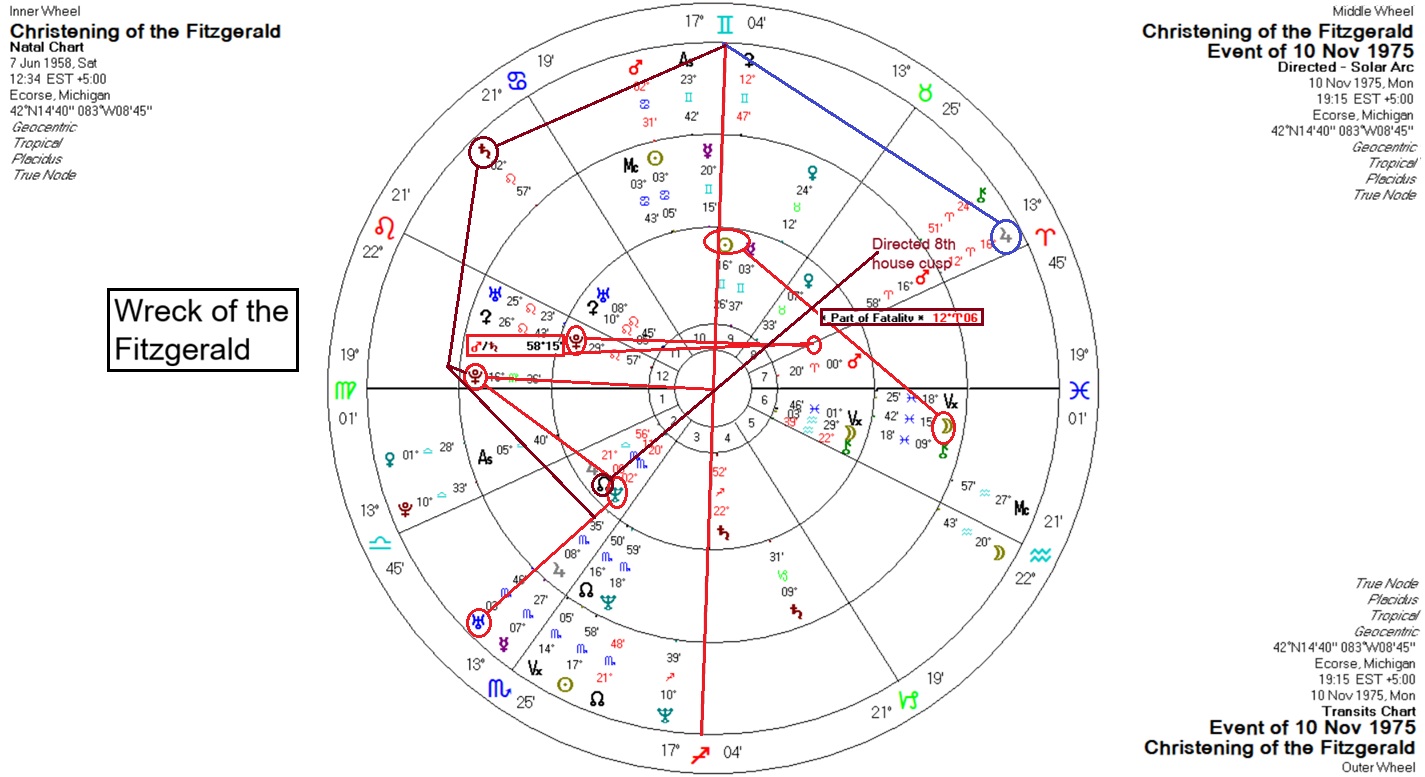
Beginning with the transits, there are several standouts. Firstly we have transiting Uranus semi-square to the christening ascendant, showing a sudden change in circumstances – the sudden storm, in other words. The ASC for the sinking was roughly at the Saturn/Uranus combination, portending a disaster. Transiting Saturn had just passed the christening Neptune as well as the christening MC by aspect.
On the other hand, we see Jupiter sextile to the Sun by transit, Saturn sextile to the christening Mercury, Mars trine to the christening Neptune as well as the christening Vertex and Jupiter in a separating sextile to the Midheaven. Overall, this would tend to show a successful voyage in terms of the more positive aspects. But then we turn to the directions.
The immediate stand out from the directions are solar arcs of Pluto square the Sun, semi-square Neptune and square to the Midheaven. In addition we see there was a solar arc of Jupiter square to the christening Uranus. A solar arc of Mars was semi-square to the Vertex. And there was a solar arc of the Moon square to the christening Sun.
Since we are looking at a death chart here, we go through our standard indicators for death, meaning directions to them by the ASC and its rulers, along with the rulers and cusp of the eighth house. These are the standard measures that one would examine for a death. But there are other factors as well. We can list them as follows:
-
- directions to and by the eighth house cusp
- the so-called death axis – the Mars/Saturn midpoint
- certain of the Arabic parts, such as the Part of Death, the part of the Fatality, the Part of Catastrophe
What do we see? The immediate stand out from the directions is the direction of the Mars/Saturn midpoint to the christening Pluto, which reads as follows:
-
- Plu=Mars/Sat: “Brutality, the rage or fury of destruction. – The intervening of Higher Power, bodily injury or harm (murder, the death of a great many people).”
In addition, the same axis was directed to the natal 8th house cusp by 45° modulus. If we look at Arabic parts the situation becomes even more interesting. The directed Part of Fatality was conjunct the natal eighth house cusp. In addition, the Part of Catastrophe was semisquare that cusp. The directed eighth house cusp was on the south node of the christening chart. And finally, in the christening chart the Part of Death was conjunct Neptune – death at sea – activated by transiting Saturn and Uranus.
Given the preceding, and going by the normal indicators of death, we see we had to dig a little bit deeper using the extra considerations listed in the bullet points. Then the situation became quite clear. This was a catastrophe that resulted in 28 deaths. And with the directed eighth house cusp on the south node, we see a cause from the past that was involved in the death of the ship.
With all these factors in mind, we see how important it is to have an accurate time for an event or birth in order to see the outcome. If we return to the event chart for the sinking, we can look to the conditions at the end of life, represented by the fourth house, or we could say the reflexive action of the Meridian axis. We find Neptune in the event chart squaring that axis, showing the fact that the cause of the sinking was never fully discovered or perhaps disclosed. It also involved death at sea. Pisces was also ay the MC, showing a maritime event.
We close this post with the final paragraph from the site where the excerpt from The Gales of November was posted:
“When (Gordon) Lightfoot sang ‘She was the pride of the American side,’ he nailed it, right there,” Sault native Roger Lelievre says. “She was the big Fitz, the mighty Fitz. And everyone knew her. She was simply the best – and that’s before anything happened.”
’Nuff said.
Featured pic from National Museum of the Great Lakes